The PBO regulatory regime comes full circle with the regulations now in place
At a glance
- With the 13 May 2026 deadline for public benefit organisations to comply with the Public Benefit Organisations Act, Cap. 134 looming, on 18 March 2026 the Kenyan Government gazetted the Public Benefit Organisations Regulations, 2026 (PBO Regulations).
- The gazettement marks a decisive shift away from the legacy non-governmental organisations regulatory framework and signals the need to review internal governance structures, constitutional documents and compliance systems ahead of the transition timeline.
- Overall, the PBO Regulations bring greater procedural clarity on registration, transition and ongoing compliance, but also introduce specific governance thresholds and an itemised fee structure that organisations should budget for.
In our previous alert, which can be accessed here, we highlighted the key changes and requirements proposed by the Proposed Draft Public Benefit Organisations Regulations (Draft Regulations) for public participation. In this alert, we outline some of the highlights of the PBO Regulations following the public participation process.
Key highlights
Residency requirements
While the PBO Act only prescribes a local presence threshold for international PBOs, the PBO Regulations extend Kenyan nationality and residency requirements across the registration categories. An application for registration as a PBO must include the particulars of its directors, a third of whom must be Kenyan nationals and resident in Kenya. A similar threshold applies to organisations seeking bestowment of PBO status and to international PBOs seeking registration. For exempt international PBOs, the PBO Regulations require at least one director to be a Kenyan national resident in Kenya.
Mandatory transition
In light of the High Court decision in Otieno and Two Others v Attorney General and Another; Katiba Institute and Nine Others (Interested Parties) [2025] KEHC 8557 (KLR), which declared unconstitutional a “fresh application” requirement for existing NGOs, the PBO Regulations nevertheless prescribe an administrative transition process for organisations registered under the repealed NGO regime. The PBO Regulations provide that, when implementing paragraph 5 of the Fifth Schedule to the PBO Act, every NGO registered before the commencement of the PBO Act shall be issued with a certificate or permit (as applicable) in accordance with the PBO Regulations, upon submission of specified information and documents to PBORA.
Tightened eligibility for bestowment and registration
The PBO Regulations introduce several refinements that will affect how organisations structure their governance, plan for compliance and budget for regulatory filings, including:
- Bestowment of status: Entities incorporated under other Kenyan laws seeking to transition to PBO status must now demonstrate that they have been undertaking public benefit activities for at least three years. The Draft Regulations had proposed a shorter one-year requirement.
- International PBOs: Similarly, international organisations must have been operating in their country of registration for at least three years prior to seeking registration or exemption in Kenya.
Relaxation of administrative timelines
The PBO Regulations offer more flexibility regarding reporting and compliance timelines compared to the Draft Regulations:
- Annual reports: PBOs are now required to submit their annual reports within six months of the end of their financial year. This is a more adaptable approach than the Draft Regulations’ proposed deadline of 31 March.
- Material changes: While the Draft Regulations proposed a flat 30-day notification for all changes, the PBO Regulations allow for 60 days to notify PBORA of changes to registration particulars or “any other change”, though notifications about changes in the governing body membership remain at 30 days.
- Name reservation: Applicants now only need to propose two names for search and reservation, down from the three names required in the Draft Regulations.
- Mandatory records: PBOs must now maintain a “detailed inventory of assets”, including the specific location of these assets.
Revised fee schedule
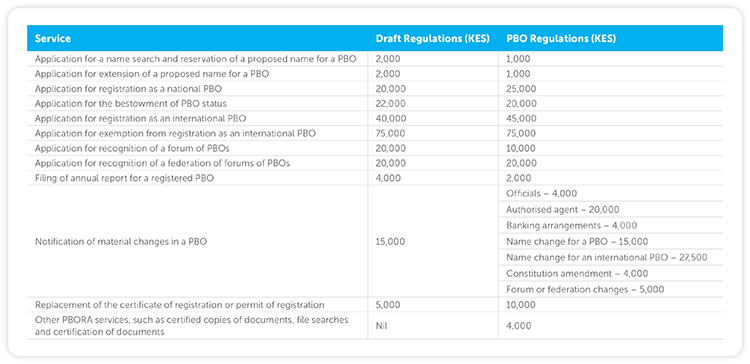
The PBO Regulations have recalibrated several fees. Notably, the cost of initial registration has increased, while the cost of certain ongoing compliance filings has been reduced.
Next steps for existing NGOs
For NGOs currently registered under the repealed Non-Governmental Organisations Co-ordination Act, Cap. 134, the transition framework requires submission of prescribed information and supporting documents to facilitate issuance of the relevant certificate or permit under the PBO regime, including:
- Information specified in Form 1.
- An authenticated copy of the organisation’s constitution.
- Minutes of the meeting resolving to register under the PBO Act and the PBO Regulations.
- Particulars of the governance structure and the existing NGO registration certificate.
- A copy of its prior NGO registration certificate.
Overall, the PBO Regulations bring greater procedural clarity on registration, transition and ongoing compliance, but also introduce specific governance thresholds and an itemised fee structure that organisations should budget for.
The information and material published on this website is provided for general purposes only and does not constitute legal advice. We make every effort to ensure that the content is updated regularly and to offer the most current and accurate information. Please consult one of our lawyers on any specific legal problem or matter. We accept no responsibility for any loss or damage, whether direct or consequential, which may arise from reliance on the information contained in these pages. Please refer to our full terms and conditions. Copyright © 2026 Cliffe Dekker Hofmeyr. All rights reserved. For permission to reproduce an article or publication, please contact us cliffedekkerhofmeyr@cdhlegal.com.
Subscribe
We support our clients’ strategic and operational needs by offering innovative, integrated and high quality thought leadership. To stay up to date on the latest legal developments that may potentially impact your business, subscribe to our alerts, seminar and webinar invitations.
Subscribe