Budget Statement FY 2026/27 highlights: What’s new, what’s next?
At a glance
- On 11 June 2026, the Cabinet Secretary for National Treasury and Economic Planning delivered the Budget Speech.
- The FY 2026/27 Budget marks a transition to a more disciplined and enforcement-oriented tax environment. The underlying message is clear: visibility has increased, and with it, the ability of the Kenya Revenue Authority to detect and act on non-compliance.
- Taxpayers who prioritise transparency, consistency and robust documentation will be better positioned to navigate this landscape.
This FY 2026/27 Budget (Budget) accessible here comes at a critical time, as the Government seeks to balance ambitious growth targets with the harsh realities of a constrained fiscal space and mounting debt-service pressures. Crafted against a backdrop of global geopolitical tensions and strong civic demands for accountability and a lower cost of living, the fiscal framework signals a definitive shift: pivoting away from aggressive tax rate hikes and debt-funded development toward administrative efficiency, base broadening and private sector led infrastructure financing.
In this alert, we highlight what this means for taxpayers. Where is the tax exposure? Will taxpayers’ positions withstand scrutiny in a data-driven system?
Economic outlook
Kenya’s Budget is set against persistent fiscal and macroeconomic pressures, but is framed around advancing the Bottom-Up Economic Transformation Agenda (BETA), with a clear emphasis on private sector led growth, job creation, improved public service delivery and fiscal sustainability.
The economy has demonstrated resilience, growing by 4.6% in 2025 and projected to expand to 5% in 2026 and 5.2% in 2027, supported by improving macroeconomic fundamentals, including exchange rate stability, adequate foreign exchange reserves, moderating inflation and a more stable interest rate environment. These gains are attributed to sustained public investment, which the Government views as a foundation for transitioning into stronger and more sustained long-term growth.
Inflation rose to 6.7% in May 2026 from 5.6% in April 2026, largely driven by higher energy costs, while foreign exchange reserves remain at approximately USD 13.2 billion (equivalent to 5.6 months of import cover), providing a buffer against external shocks. The fiscal framework projects total revenue of KES 3.631 trillion against expenditure of KES 4.82 trillion, resulting in a deficit of KES 1.15 trillion (5.5% of GDP). Overall, the Budget reflects a shift towards a more targeted growth model anchored on private sector participation, fiscal discipline and efficient public spending, with strategic focus on human capital, innovation, technology and infrastructure. Its success will largely depend on implementation effectiveness and the ability to mobilise private investment to bridge financing gaps and sustain growth amid ongoing fiscal constraints.
Budget overview
The FY 2026/27 fiscal framework reflects an expansionary expenditure plan paired with emphasis on enhancement of domestic revenue mobilisation and restraint on expenditure.
Compared to FY 2025/26, the FY 2026/27 Budget has higher revenue targets, slightly reduced development spending and heavier reliance on domestic borrowing to finance the significantly larger fiscal deficit.
Comparative analysis: FY 2025/26 v FY 2026/27 Budget
![table 1[38]](/export/sites/cdh/news/publications/2026/Kenya/Tax-Exchange-Control/Downloads/table-138.png "table 1[38]")
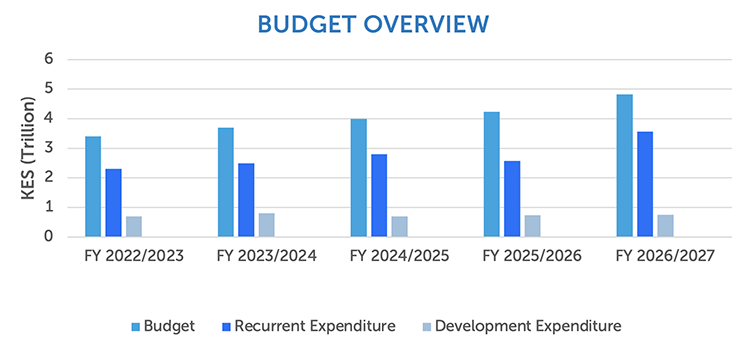
The chart below presents a five-year trend in Kenya’s national budget, comparing total expenditure with recurrent and development spending across fiscal years.
Policy direction and revenue strategy
The Government’s revenue mobilisation strategy is anchored on domestic borrowing, with an intention to reduce reliance on external borrowing. This has translated into a focus on expanding the tax net and ensuring that existing taxes are fully collected. Rather than overburdening already compliant taxpayers through higher rates, the approach seeks to bring into the tax net those who have historically remained outside or on the margins of formal compliance.
This shift is being supported by significant investment in technology. The integration of platforms such as eTIMS, iTax, customs systems, and third-party data sources allows the KRA to develop a complete and accurate picture of taxpayer activity. As the integration continues, discrepancies between declared income, transactional data and financial records will become increasingly visible.
Consequently, compliance is no longer a periodic obligation tied to filing deadlines. It is evolving into a continuous process where transactions are effectively monitored in real-time. This has profound implications for how businesses structure their operations, maintain records, and manage tax risk.
Increased emphasis on enforcement
A defining feature of this budget cycle is the prioritisation of enforcement. The KRA is likely to intensify compliance checks and audits, supported by enhanced analytical tools and broader access to data. This will likely result in more assessments as the traditional reliance on low compliance audit or assessment probability as a risk management strategy is no longer viable.
Importantly, enforcement is not limited to large corporates. Small and medium-sized enterprises (SMEs), professionals and participants in the informal sector are increasingly within scope. Digital footprints, including tax compliant electronic invoicing requirements, have made it easier to identify and assess previously underreported income streams.
Additional tax revenue arising from Finance Bill, 2026 measures
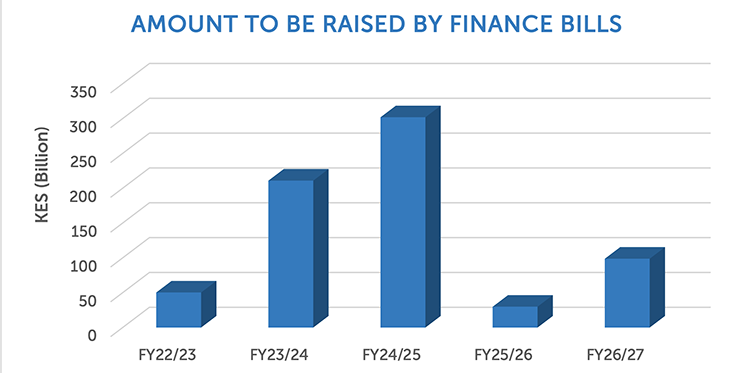
The Finance Bill, 2026 (Finance Bill) targets additional tax revenue collection of KES 98.9 billion in the coming fiscal year. It deliberately avoids introducing new taxes that would further burden taxpayers. Instead, it zeroes in on compliance, base expansion and targeted exemptions to spur specific sectors.
Trends in revenue collection
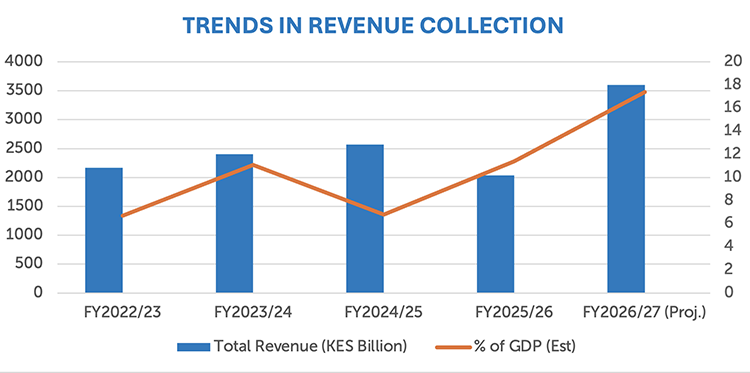
The total revenue for FY 2026/27 is projected at KES 3.6 trillion, equivalent to 17.4% of GDP, compared to an estimated KES 3.3 trillion (17.2% of GDP) in FY 2025/26. This reflects a modest but deliberate effort to enhance domestic revenue mobilisation within a constrained fiscal environment.
The projected revenue comprises:
- Ordinary revenue: KES 2.986 trillion (14.3% of GDP)
- Ministerial AIA: KES 644.8 billion (3.1% of GDP)
- Grants: KES 43.6 billion (0.2% of GDP)
While the growth trajectory remains positive, the relatively marginal increase as a share of GDP underscores the structural challenges in expanding the tax yield without placing additional strain on existing taxpayers.
The following graph illustrates the trend in total revenue, highlighting projected collections for FY 2026/27 in comparison to the last five fiscal years.
To support these revenue targets, the Government is increasingly relying on policy and administrative measures aimed at enhancing domestic resource mobilisation. These include:
Expanding KRA’s administrative authority and enforcement reach
The Finance Bill signals a deliberate policy shift toward strengthening the enforcement mandate of the KRA, primarily by consolidating and expanding the Commissioner’s statutory powers while scaling back certain procedural safeguards available to taxpayers. A key proposal is to allow the Commissioner to issue assessments based on third-party data, electronic systems and historical filings, effectively reducing reliance on taxpayer self-declarations. While this aligns with modern revenue administration practices, the absence of clear standards governing data accuracy, verification thresholds and taxpayer recourse introduces material uncertainty and heightens the risk of contentious assessments.
Further, the proposed consolidation of general anti-avoidance rules into a single, broader framework under the Tax Procedures Act significantly widens the scope of arrangements that may be challenged, potentially capturing legitimate commercial transactions. Coupled with provisions allowing enforcement action such as agency notices even where disputes are under appeal, and shortened compliance timelines, the reforms tilt the balance decisively in favour of the KRA, raising concerns around due process, dispute escalation and overall investor confidence.
Transition to a data-driven tax administration
The Government is increasingly anchoring tax administration on technology and data analytics, marking a transition from a self-assessment regime to a real-time, data-led compliance model. Central to this is the proposed expansion of pre-populated tax returns, generated from transactional data held by the KRA. While this has the potential to ease compliance and improve efficiency, it simultaneously transfers a greater verification burden onto taxpayers, who remain legally responsible for inaccuracies in system-generated data.
The move toward mandatory electronic invoicing, filing and payment further entrenches digital compliance, supported by stricter enforcement mechanisms and penalties for non-compliance. In addition, the introduction of a reporting framework for Virtual Asset Service Providers reflects a clear intention to bring emerging sectors within the tax net through enhanced transparency. Collectively, these measures will require taxpayers to invest in robust internal systems, data governance frameworks and audit trails to mitigate the heightened risk of mismatches, system errors and compliance disputes in an increasingly automated tax environment.
Widening the scope of taxable transactions and sectors
Consistent with the Government’s stated objective of avoiding increases in headline tax rates, the Finance Bill adopts an expansive approach to widening the tax base by targeting previously under-taxed sectors and transactions. Notably, the introduction of withholding tax on card transaction fees, such as interchange and merchant service fees, could increase the cost of digital payments and inadvertently discourage cashless transactions, particularly where gross-up obligations apply to non-resident recipients.
The proposed removal of the 20% threshold for taxing indirect share disposals significantly broadens Kenya’s capital gains tax regime, bringing into scope any non-resident disposals of shares deriving value from Kenya, regardless of materiality. However, the lack of a clear definition of “value” introduces interpretative uncertainty and risks overreach, potentially affecting offshore transactions with only a remote Kenyan nexus.
Additionally, the reclassification of certain supplies from zero-rated to exempt for value-added tax (VAT) purposes will restrict input VAT recovery, effectively embedding irrecoverable tax costs into pricing structures.
Taken together, these measures reflect a strategic shift toward revenue mobilisation through base expansion, but they also raise legitimate concerns regarding increased tax costs, complexity and the potential dampening effect on investment and economic activity.
Key sectoral allocations
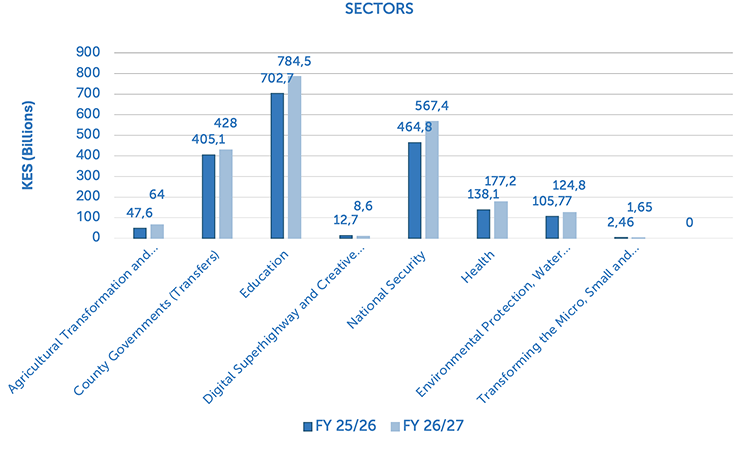
The chart below compares sectoral budget allocations for FY 2026/27 against FY 2025/26, highlighting shifts in government spending priorities across key areas such as education, health, national security, agriculture and county transfers.
Top sectoral increases
The FY 2026/27 Budget reflects notable increases in allocations to sectors aligned with agricultural transformation and inclusive growth, national security and internal administration, and education. The largest winners are outlined below.
![table 3[5]](/export/sites/cdh/news/publications/2026/Kenya/Tax-Exchange-Control/Downloads/table-35.png "table 3[5]")
Top sectoral reductions
Conversely, several sectors experienced significant reductions in funding, reflecting a shift in fiscal prioritisation.
![table 2[98]](/export/sites/cdh/news/publications/2026/Kenya/Tax-Exchange-Control/Downloads/table-298.png "table 2[98]")
Implications for sectors
The impact of these developments will vary across sectors, but certain patterns are already evident. Businesses operating in the digital economy will continue to face close attention, particularly where services are provided across borders or through non-resident structures. The challenge here lies in determining the appropriate tax presence and ensuring that compliance obligations are properly discharged.
For importers and manufacturers, customs enforcement is expected to tighten. Valuation disputes may become more common, especially in related-party transactions where pricing may be questioned. This places a premium on maintaining robust documentation and ensuring that pricing methodologies can be justified on commercial grounds.
Professional service providers and SMEs will experience increased pressure to formalise their operations. The use of simplified tax regimes may expand, but this will be accompanied by stricter monitoring to ensure that declared turnover aligns with actual economic activity.
Emerging risk areas
One of the most significant risks is the issue of data inconsistency. As systems become interconnected, the KRA is able to cross-reference information from multiple sources, including banks, suppliers and government platforms. Any mismatch between these datasets and the taxpayer’s declarations can trigger a compliance audit or investigation.
Historical non-compliance also represents a growing area of exposure. With improved analytical capability, the KRA is better positioned to reconstruct past transactions and raise assessments for prior periods. This means that legacy issues which may have been considered dormant could resurface.
There is also an increasing focus on the principle of substance over form. Arrangements that are legally structured but lack genuine commercial purpose are more likely to be challenged. This is particularly relevant in group structures, cost allocations and cross-border arrangements.
Strategic opportunities for taxpayers
Despite the heightened enforcement environment, there are clear opportunities for proactive taxpayers. One of the most important is the ability to undertake a comprehensive review of existing tax positions and address any weaknesses before they are identified by the KRA. This may involve correcting prior filings, improving documentation or restructuring certain arrangements.
There is also scope to enhance tax efficiency through legitimate planning. This includes optimising group structures, making appropriate use of available incentives and aligning operational models with tax requirements. The key is to ensure that such planning is grounded in commercial reality and can be supported with evidence.
Another critical area is dispute preparedness. Given the likelihood of increased compliance audits, taxpayers should adopt an audit-ready strategy. This means maintaining clear and accessible documentation, articulating defensible positions and engaging professional advisors early in the process.
Status of the Finance Bill, 2026
The Departmental Committee on Finance and National Planning (Committee) tabled its report on the Finance Bill, 2026 on Tuesday, 16 June 2026, providing insights into the proposed legislative framework. The report is accessible here.
The Finance Bill has gone through public participation exercise, and it is now being considered by Parliament. At this point in the legislative process only Parliament can make amendments to the Finance Bill. Our detailed analysis of the proposed tax measures in the Finance Bill, 2026 is available here.
Practical way forward
In light of the Finance Bill’s proposals and the Budget, taxpayers should take deliberate steps to strengthen their compliance frameworks. This begins with a thorough tax health check to identify potential areas of exposure. Particular attention should be paid to the alignment between financial statements, tax filings and transactional data.
It is equally important to invest in internal controls and processes that support accurate and consistent reporting. As compliance becomes more data-driven, the integrity of underlying systems and records will be critical. Businesses should also consider digitising their compliance functions to improve efficiency and reduce the risk of error.
Over the longer term, tax should be integrated into strategic decision-making. Rather than being treated as a reactive function, it should inform how transactions are structured and how risks are managed.
Conclusion
The FY 2026/27 Budget marks a transition to a more disciplined and enforcement-oriented tax environment. The underlying message is clear: visibility has increased, and with it, the ability of the KRA to detect and act on non-compliance.
For taxpayers, the imperative is to adapt. Those who prioritise transparency, consistency and robust documentation will be better positioned to navigate this landscape. Conversely, reliance on informal practices or weak structures will carry significantly higher risk.
Ultimately, the focus should shift from merely complying with the law to ensuring that all tax positions are sustainable under scrutiny. In the current environment, that distinction is critical.
The information and material published on this website is provided for general purposes only and does not constitute legal advice. We make every effort to ensure that the content is updated regularly and to offer the most current and accurate information. Please consult one of our lawyers on any specific legal problem or matter. We accept no responsibility for any loss or damage, whether direct or consequential, which may arise from reliance on the information contained in these pages. Please refer to our full terms and conditions. Copyright © 2026 Cliffe Dekker Hofmeyr. All rights reserved. For permission to reproduce an article or publication, please contact us cliffedekkerhofmeyr@cdhlegal.com.
Subscribe
We support our clients’ strategic and operational needs by offering innovative, integrated and high quality thought leadership. To stay up to date on the latest legal developments that may potentially impact your business, subscribe to our alerts, seminar and webinar invitations.
Subscribe