customs and excise
At a glance
- An overview of the customs and excise changes introduced in the 2026 Budget.
Excisable products
Alcohol
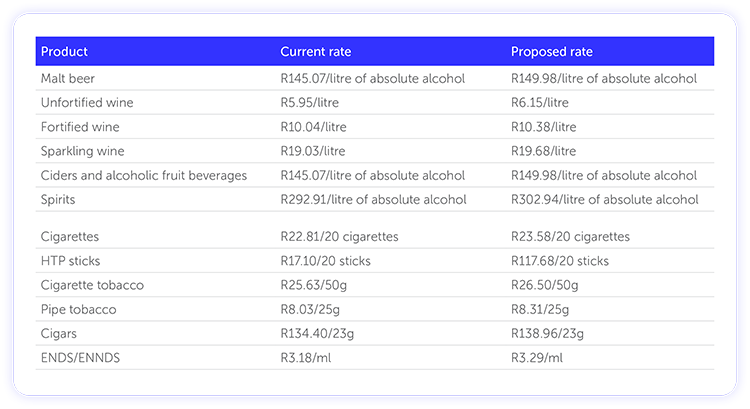
- Government proposes to increase excise duties on alcoholic beverages in line with the inflation forecast of 3.4% for 2026/27. Stakeholder consultations on the alcohol excise review will continue during 2026.
Tobacco
- Government also proposes to increase excise duties on tobacco products in line with expected inflation. This includes excise duty on electronic nicotine and non-nicotine delivery systems (vaping). The excise duty adjustments will take effect on 1 April. The required legislative amendments will form part of the taxation laws amendment bills this year.
Relevant structures as follows
- As was the case last year, there will be no change to the excise duty on traditional African beer (umqombothi) and traditional African beer powder.
Fuel taxes
- From 2015 to 2025 taxes as a percentage of the pump price averaged 33.4% for petrol and 35.7% for diesel. The tax burden for petrol peaked in 2015/16 at 40.9%, and for diesel in 2020/21 at 45%. From 2022/23, the tax burden for petrol and diesel has remained below 35% due to higher fuel prices and because fuel levies were not increased for three years.
- Fuel prices have remained subdued and it is proposed that from 1 April the general fuel levy is increased by less than inflation to R4.10/litre for petrol and R3.93/litre for diesel. The Road Accident Fund (RAF) levy will be increased by 7c/litre to R2.25/litre from 1 April, in line with expected inflation, while the customs and excise levies remain unchanged.
Carbon tax
- It increased from R236 to R308 per tonne of carbon dioxide equivalent from 1 January 2026.
- The carbon fuel levy will increase to 19c/litre for petrol and 23c/litre for diesel from 1 April 2026, as required under the Carbon Tax Act. The combined increase in fuel levies from the general fuel levy, the carbon fuel levy and the RAF levy is in line with expected inflation. The carbon tax cost recovery quantum for the liquid fuels sector will be increased from 0.99c/litre to 1.29c/litre from 1 January 2026 to align with the increase of the headline carbon tax rate.
General
- The ATA Carnet system, established under the ATA and Istanbul Conventions, enables the temporary admission of certain goods such as commercial samples, professional equipment and exhibition items into foreign territories without the payment of duties or taxes. Carnets were historically issued in paper form by the National Guaranteeing Associations and manually processed at border posts. The World Customs Organization and the International Chamber of Commerce have launched an electronic ATA Carnet Project, which mandates fully digitised carnets. To ensure that South Africa can implement the new requirements of the international agreement, an amendment to the Customs Act is proposed to enable the Commissioner to issue rules relating to the issuing, use and submission of international carnets when goods are temporarily imported or exported.
- The insertion of section 17A in the Carbon Tax Act in 2025 provides for a refund where an entity complies with carbon budgets over a five-year period. Carbon tax refunds are administered in terms of the Customs Act and a two-year prescription period applies for customs and excise refund claims. It is therefore proposed that the Customs Act be amended to facilitate the administration of carbon tax refunds claimed over a longer period.
- Section 75(10) of the Customs Act gives the Commissioner broad discretion to exempt or condone non-compliance by taxpayers who fail to meet conditions or requirements prescribed by rule or in the notes to Schedules Three, Four and Six in respect of any goods specified in an item of these schedules. The modern legislative approach is to move away from broad discretions and provide criteria for the exercise of discretions to enhance clarity and certainty. It is proposed that the discretion be redrafted accordingly.
- When the carbon fuel levy was introduced pursuant to the Carbon Tax Act, SARS systems were not designed to facilitate the separate payment of these levies. As a result, the carbon fuel levy applicable to petrol and diesel was included as part of the general fuel levy provided for in Part 5A of Schedule One to the Customs Act. Since the implementation of the carbon fuel levy, new tariff items attracting this levy have been introduced by the Taxation Laws Amendment Act 42 of 2024. Systems changes were required to accommodate the integration of these new tariff items, and the carbon fuel levy can now be separated from the general fuel levy. It is proposed that a new Part 5C be inserted into Schedule One to provide separately for the administration of the carbon fuel levy.
- Taxing electronic heated tobacco products based on tobacco content (weight) rather than by stick (quantity) is considered a more effective public health strategy because it reduces the industry’s ability to control the tax base and encourages healthier consumer choices. It is proposed that the statistical unit of measure “per 10 sticks” be changed to “per kilogram net” for electronic heated tobacco products.
- The global diamond industry is in transition and domestic producers are feeling the effects. To encourage diamond producers to sell unpolished stones to local cutters and polishers, a 5% levy is applied on the value of unpolished diamonds released for export. Producers are exempt from paying this levy if they meet local sales requirements. Different thresholds are applied to producers of different sizes. Large producers must sell 40% locally, and medium producers 15%. To continue support for the domestic industry, Government proposes to lower the threshold separating large and medium producers from R3 billion to R2 billion and allow large producers to choose between selling 15% locally and offering the remaining output to the Diamond Exchange and Export Centre (DEEC) or selling 40% locally and being exempt from offering the remaining production to the DEEC. Stakeholder consultation will continue after Budget Day.
The information and material published on this website is provided for general purposes only and does not constitute legal advice. We make every effort to ensure that the content is updated regularly and to offer the most current and accurate information. Please consult one of our lawyers on any specific legal problem or matter. We accept no responsibility for any loss or damage, whether direct or consequential, which may arise from reliance on the information contained in these pages. Please refer to our full terms and conditions. Copyright © 2026 Cliffe Dekker Hofmeyr. All rights reserved. For permission to reproduce an article or publication, please contact us cliffedekkerhofmeyr@cdhlegal.com.
Subscribe
We support our clients’ strategic and operational needs by offering innovative, integrated and high quality thought leadership. To stay up to date on the latest legal developments that may potentially impact your business, subscribe to our alerts, seminar and webinar invitations.
Subscribe