The expanded definition of “employee”: What you need to know about the 2025 Labour Law Amendment Bill
Among the most significant of the proposed amendments is the introduction of an expanded definition of “employee” under both the Labour Relations Act, 1995 (LRA) and the Basic Conditions of Employment Act, 1997 (BCEA). The Explanatory Memorandum to the LRA Amendment Bill acknowledges that changes in the nature and organisation of work have resulted in an increasing proportion of the South African workforce falling outside the statutory definition of an employee, with the result that they do not receive the protections of labour legislation.
In this alert, we examine the existing definitions of “employee”, the proposed expanded definitions, the rebuttable presumptions that accompany them, and the practical implications for employers.
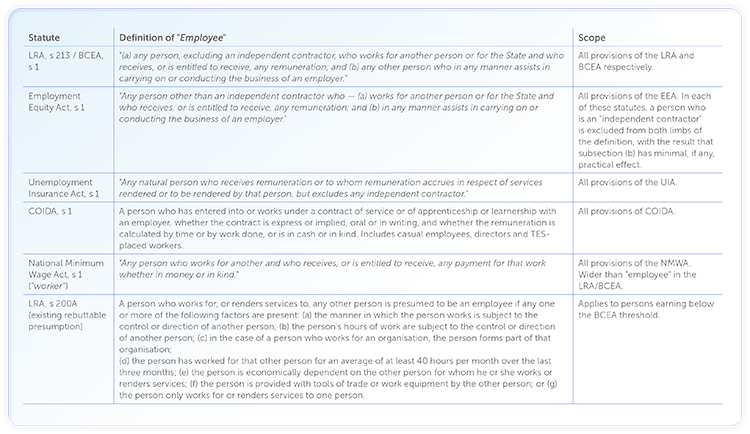
The Existing Definitions of “Employee” in South African Labour Law
The definition of “employee” is not uniform across South African legislation. The scope of each statute’s coverage is determined by its own definition, and these definitions differ in material respects.
The Proposed Expanded Definitions
Neither Bill amends the general definitions of “employee” in section 1 of the BCEA or section 213 of the LRA. Instead, each Bill introduces a new, broader definition that applies only for limited purposes.
Schedule 11 of the LRA Amendment Bill
The LRA Amendment Bill proposes to add a new Schedule 11 to the Act. For the purposes of this Schedule, an “employee” means “an individual, other than an employee as defined in section 213 of the Act, who works for a person that is not a client or customer of any profession, business or undertaking carried on by the individual.” The Bills now also define who qualifies as an “employer” for the purposes of these provisions. Schedule 11 provides that an “employer” means “any person or entity for whom an employee works.”
Schedule 11 extends the rights contained in Chapter II (freedom of association), Chapter III (collective bargaining) and Chapter IV (the right to strike) to persons who satisfy this expanded definition. Existing trade unions will be entitled to alter their constitutions to enable them to recruit workers falling in this category.
Section 50A of the BCEA Amendment Bill
The BCEA Amendment Bill proposes to insert a new section 50A, which provides: “Notwithstanding the definition of employee, for purposes of Chapter 8 - (a) ‘employee’ also means any individual who performs work or provides services for another person and who is not conducting an independent trade, profession or business in which the person receiving the work or services is a client or customer.” Section 50A likewise provides that an “employer” includes “any person or entity for whom an employee works.” This definition is identical to the Schedule 11 definition of “employer” under the LRA Amendment Bill.
Clause 6 of the BCEA Amendment Bill further proposes to amend section 62A to make the definition of “employee” introduced by section 50A applicable to the provisions in Chapter 10 of the BCEA (monitoring, enforcement and legal proceedings). The practical effect is that workers captured by this expanded definition will be subject to sectoral determinations made by the Minister under Chapter 8, and will have access to the compliance and enforcement machinery of Chapter 10.
Key Differences Between the Two Definitions
While both definitions pursue the same objective, their wording differs in ways that may produce divergent outcomes.
The Schedule 11 definition uses the phrase “works for a person” - a simpler formulation - whereas section 50A uses the more expansive phrase “performs work or provides services for another person.”
The exclusion clause in section 50A requires that the person is “not conducting an independent trade, profession or business in which the person receiving the work or services is a client or customer.” The phrase “in which” may mean that even if a person is independent in all other respects, the exclusion only applies if the person receiving the work or services is a client or customer of that specific trade, profession or business.
The Three Rebuttable Presumptions
Both provisions create a presumption that an individual is an employee unless the employer demonstrates that all three of the following factors are satisfied:
(a) the person is not subject to the control and direction of the employer in connection with the performance of the work or provision of the services;
(b) the person is not part of the organisation of the employer; and
(c) the person does not perform work for or provide services to customers or clients on behalf of the employer under terms set by the employer.
Practical Implications for Employers
The expanded definitions create what the Explanatory Memorandum describes as a category of workers “now often referred to by the internationally used term of ‘dependent contractors’.” These are workers who fall between the traditional categories of employee and independent contractor. They appear to be the primary target of the amendments.
Reclassification risk. The Bills create de lege employee status for platform workers, gig economy participants and de facto dependent contractors until the employer proves otherwise. The third rebuttable presumption - “terms set by the employer” - is particularly onerous, as even genuine independent sub-contractors commonly work under principal set terms of engagement based on commercial requirements.
The Bills and Explanatory Memoranda do not define “client or customer”, do not explain what counts as “terms set by the employer”, and do not specify what “on behalf of” means in ordinary contracting chains.
Industries most affected. The amendments are likely to affect platform and gig economy companies (e-hailing, food delivery, freelance platforms), companies using independent contractor models (owner-driver distribution networks, independent sales agents, and commission-based contractors), and outsourcing and facilities management companies.
Limited scope of rights. It is important to note that employees under the expanded definitions do not receive the full suite of LRA and BCEA protections. Under the LRA, they gain freedom of association, organisational rights, collective bargaining and the right to strike - but not unfair dismissal protection (save for strike-related automatically unfair dismissals) or unfair labour practice protection. Under the BCEA, they gain access to sectoral determinations and the compliance and enforcement machinery, but not the general protections regarding working hours, leave, or other basic conditions.
What Employers Should Do Now
The Bills are currently open for public comment. Employers who rely on independent contractor models, particularly in the platform economy, gig economy, outsourcing and distribution sectors, should audit their existing arrangements to assess reclassification exposure under the expanded definitions. Affected employers should also consider making submissions during the public comment period.
The information and material published on this website is provided for general purposes only and does not constitute legal advice. We make every effort to ensure that the content is updated regularly and to offer the most current and accurate information. Please consult one of our lawyers on any specific legal problem or matter. We accept no responsibility for any loss or damage, whether direct or consequential, which may arise from reliance on the information contained in these pages. Please refer to our full terms and conditions. Copyright © 2026 Cliffe Dekker Hofmeyr. All rights reserved. For permission to reproduce an article or publication, please contact us cliffedekkerhofmeyr@cdhlegal.com.
Subscribe
We support our clients’ strategic and operational needs by offering innovative, integrated and high quality thought leadership. To stay up to date on the latest legal developments that may potentially impact your business, subscribe to our alerts, seminar and webinar invitations.
Subscribe