Labour Law Amendment Bill, 2025: proposed reforms now open for public comment
This article summarises the most significant proposed changes, with particular focus on the major amendments to the BCEA and the LRA. The BCEA was last amended in 2020 and the LRA was last amended in 2019. The Bill also amends the UIA to align parental benefits with the BCEA amendments.
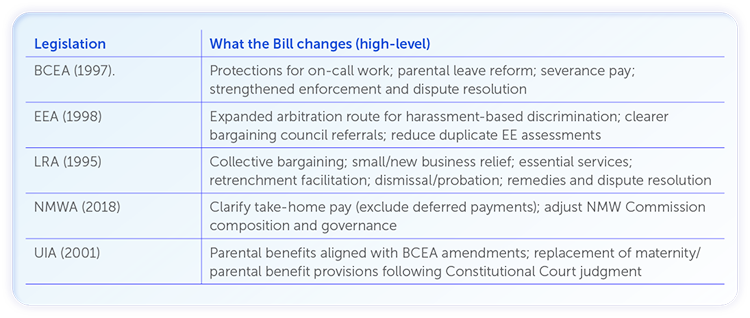
The BCEA: major proposed amendments
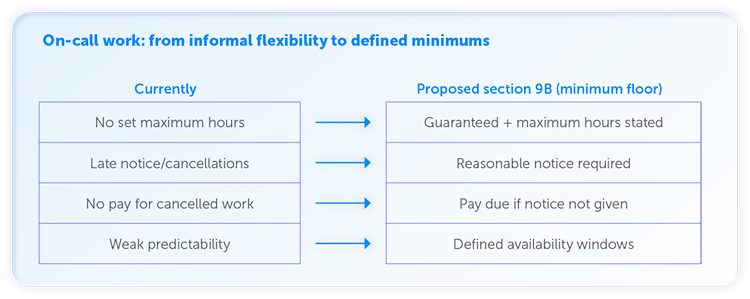
On-call work: minimum safeguards for unpredictable scheduling
A new framework is proposed for employees earning below the BCEA earnings threshold who are required to work only when work is made available (so called on-call or zero-hours workers). The reforms are designed to introduce predictability and protect employees from last-minute cancellations and volatile hours.
Employers would be required to specify, in written particulars:
- Maximum hours per period
- Period the employee must be available to work
- The notice period for reporting to work and for cancellation
The notice for reporting or cancellation must be reasonable, assessed against operational and worker-impact factors. Where cancellation occurs without the required notice, the employer must remunerate employees for cancelled work hours.
Parental leave: a redesigned model
The parental leave framework is proposed to be streamlined and made more inclusive, creating a unified parental leave right for parents of newborn children, adopted children and children born through surrogacy arrangements in accordance with the Constitutional Court judgment in Van Wyk and Others v Minister of Employment and Labour; Commission for Gender Equality and Another v Minister of Employment and Labour and Others.
High-level summary
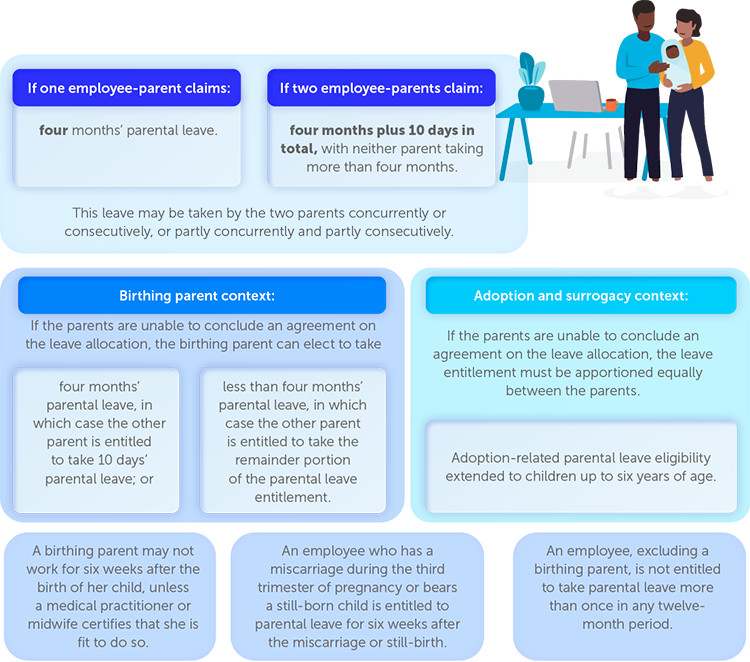
The Bill retains an advance written notice requirement (generally at least four weeks).
Severance pay: doubling the statutory floor (prospectively)
The Bill proposes increasing statutory severance pay for operational requirements dismissals from one week to two weeks’ remuneration per completed year of service. A transitional approach is proposed so that the increased entitlement applies prospectively to completed years of service commenced after the amendment comes into effect.
Severance disputes may be referred to the CCMA for arbitration where fairness is not challenged, which is intended to reduce duplicated proceedings and jurisdictional disputes.
Enforcement and dispute resolution: stronger tools, fewer procedural detours
- Expanded enforcement definitions of employee and employer for compliance purposes.
- Recognised union representatives may accompany labour inspectors during inspections.
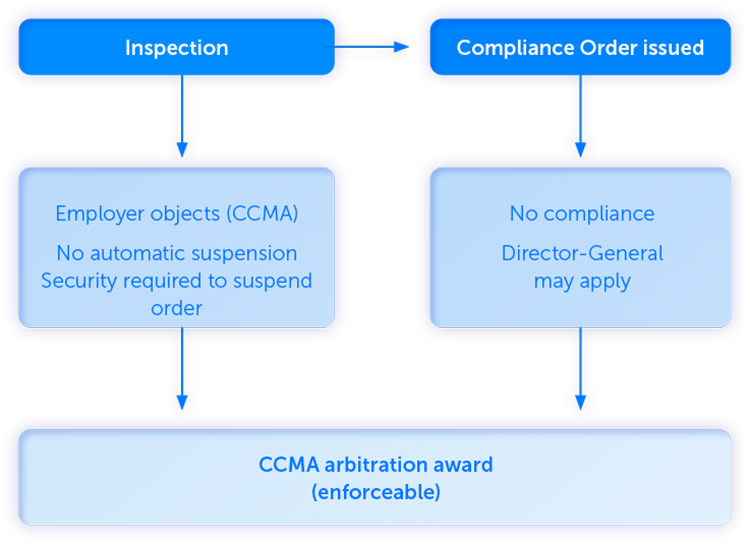
- Objections to compliance orders do not automatically suspend the order unless security is provided to the CCMA.
- Clearer, faster routes for the CCMA to arbitrate objections and convert non-complied compliance orders into enforceable awards.
- Ability to consolidate BCEA and NMWA disputes with claims under other employment laws.
- Fines paid for failure to pay the national minimum wage must be paid over to the affected employee.
- A framework for claims about unpaid benefit fund contributions and interest, while avoiding duplication where another tribunal has already determined the issue.
Compliance orders: proposed faster enforcement pathway
The EEA: major proposed amendments
Harassment-based discrimination: expanded CCMA arbitration
Currently, employees may only refer sexual harassment claims to CCMA arbitration. The Bill proposes expanding this to allow employees to refer any unfair discrimination claim based on harassment (including harassment on grounds of race, gender, disability or other listed grounds) to the CCMA for arbitration, provided conciliation has not resolved the dispute.
Bargaining council referrals: clearer pathways
A new section 10A clarifies the circumstances in which EEA disputes may be referred to a bargaining council. Such a dispute may be referred where this is provided for in a collective agreement or where the bargaining council has been accredited by the CCMA to perform this function.
Certificate of Compliance: preventing duplicate assessments
The Bill proposes that an employer’s Certificate of Compliance under the EEA will constitute proof of employment equity compliance under any other law. This is intended to prevent employers from being assessed multiple times for employment equity compliance under different legislation.
The NMWA: major proposed amendments
Take-home pay: excluding deferred payments
The Bill proposes clarifying that deferred payments (such as retirement fund contributions) are excluded from the wage calculation when determining compliance with the national minimum wage. This is intended to ensure that the minimum wage reflects actual take-home pay, following the Labour Appeal Court decision in Quantum Foods (Pty) Ltd v Commissioner Jacobs and others [2024] BLLR 32 (LAC) that raised concerns about the purpose of the NMWA being undermined. The Bill also removes the requirement for a separate minimum wage review for farm and domestic workers.
The UIA: major proposed amendments
Parental benefits: aligned with BCEA amendments
The Bill proposes repealing and replacing sections 24 to 29C of the UIA with new provisions regulating parental benefits. This aligns the UIA with the BCEA amendments following the Constitutional Court judgment in Van Wyk and Others. A single parent or sole UIF contributor will be entitled to 17.32 weeks of parental benefits; two contributors may share 17.32 weeks plus 10 days.
Terminology change: maternity to parental benefits
References to “maternity” benefits are changed to “parental” benefits throughout, reflecting the new unified parental leave framework.
The LRA: major proposed amendments
The Bill proposes reforms aimed at strengthening collective bargaining, unblocking dispute resolution systems, and calibrating protections in response to labour-market realities.
Collective bargaining legitimacy: expanded secret-ballot requirements
The Bill proposes that ballots to terminate or extend closed shop agreements must be conducted by secret ballot and introduces consequences if ballots are not held within prescribed periods. It also proposes secret-ballot requirements before a trade union or employers’ organisation may reject certain advisory arbitration awards in specific strike and lock-out contexts.
Small and new business: temporary relief from bargaining council terms
Newly established employers employing fewer than 50 employees may, under the proposal, be excluded from bargaining council terms and conditions for the first two years of operation, subject to exclusions designed to prevent restructuring abuse. During this period, the employer would still need to comply with all other labour laws.
Essential services: protected strikes where minimum services exist
The Bill proposes clarifying when employees in essential services may embark on protected strike action where a minimum service agreement or determination exists, after the statutory conciliation process, provided that minimum service employees do not participate.
Retrenchments and facilitation: simplifying section 189A
- Empowering the CCMA to make rules for facilitation, rather than relying primarily on ministerial regulations.
- Clarifying when Labour Court referral may proceed after facilitation without a further conciliation step.
- Removing complex procedural fairness challenges during facilitation and restoring a clearer post-dismissal challenge route.
- Allowing a facilitator appointed under section 189A to determine picketing rules in a similar manner to a commissioner.
Dismissals: probation and expanded inquiry-by-arbitrator mechanisms
Two proposed changes are likely to attract close attention. First, unfair dismissal protections may not apply to new employees during their first three months, or for a longer probation period where that period is reasonable and operationally justifiable. Second, contracts may more readily provide for an inquiry by arbitrator through the CCMA, a bargaining council or an accredited agency, as a way to reduce downstream disputes.
Remedies and compensation: differentiating high-paid employees
The Bill proposes adjustments to remedies, including limiting reinstatement for employees earning above R1,800,000 per annum (adjusted annually for CPI) generally to cases of automatically unfair dismissal. It also proposes limits on compensation calculations and a mechanism for the Minister to prescribe and annually adjust the applicable maximum earnings level.
Dispute resolution
The Bill proposes steps to reduce duplication and improve enforceability, including:
- Wider recognition for bargaining councils, statutory councils and agencies to conciliate or arbitrate matters under any employment law.
- CCMA assistance for low-paid workers to enforce awards, including instructing sheriffs and paying related fees in appropriate cases.
- Allowing money awards to be enforced as orders of either the Labour Court or the Magistrates’ Court.
- A new Schedule 11 is proposed to extend freedom of association and collective bargaining rights to workers who fall outside the traditional definition of “employee”. This would enable such workers to form or join trade unions, exercise organisational rights, and engage in collective bargaining and industrial action in accordance with the LRA’s procedures.
- Requiring employees challenging dismissal to elect whether they proceed on unfairness or unlawfulness, aimed at preventing parallel claims.
What to do now
Stakeholders should consider the operational and compliance implications of these proposals, particularly around on-call scheduling practices, parental leave planning and notice processes, severance cost projections, enforcement exposure, probation and dismissal design, and large-scale retrenchment facilitation steps.
Look out for our detailed guideline on the full amendments, to be published shortly.
The information and material published on this website is provided for general purposes only and does not constitute legal advice. We make every effort to ensure that the content is updated regularly and to offer the most current and accurate information. Please consult one of our lawyers on any specific legal problem or matter. We accept no responsibility for any loss or damage, whether direct or consequential, which may arise from reliance on the information contained in these pages. Please refer to our full terms and conditions. Copyright © 2026 Cliffe Dekker Hofmeyr. All rights reserved. For permission to reproduce an article or publication, please contact us cliffedekkerhofmeyr@cdhlegal.com.
Subscribe
We support our clients’ strategic and operational needs by offering innovative, integrated and high quality thought leadership. To stay up to date on the latest legal developments that may potentially impact your business, subscribe to our alerts, seminar and webinar invitations.
Subscribe