From queue to contest - Significant reforms to the acquisition of petroleum rights and permits
At a glance
- The process for acquiring upstream rights and permits has undergone significant reform. Recent legislative and regulatory changes, including the enacting of the Upstream Petroleum Resources Development Act 23 of 2024, have streamlined application pathways, clarified institutional responsibilities, and strengthened environmental and governance requirements.
- The previous fragmented system has been replaced with a more integrated licensing framework, reducing procedural duplication and improving predictability for investors.
- The Upstream Petroleum Resources Development Act 23 of 2024 empowers the Minister of Mineral and Petroleum Resources to initiate competitive licensing rounds or open licensing rounds. This is in contrast to first come, first served application process under the Mineral and Petroleum Resources Development Act 28 of 2002.
The entry point to exploration under the MPRDA is via an application stream, with companies typically applying for a one-year reconnaissance permit or technical co-operation permit over an area, with holders of technical co-operation permits able to exercise their exclusive right to apply for an exploration right over the same area in accordance with section 78 of the MPRDA. Thereafter, and should a discovery be made, such company would be able to exercise its exclusive right to apply for a production right over the area in accordance with section 82(1)(a) of the MPRDA. The MPRDA model is first come, first served, with exclusivity often flowing from the earlier right or permit, and decisions to accept applications taken against general statutory criteria.
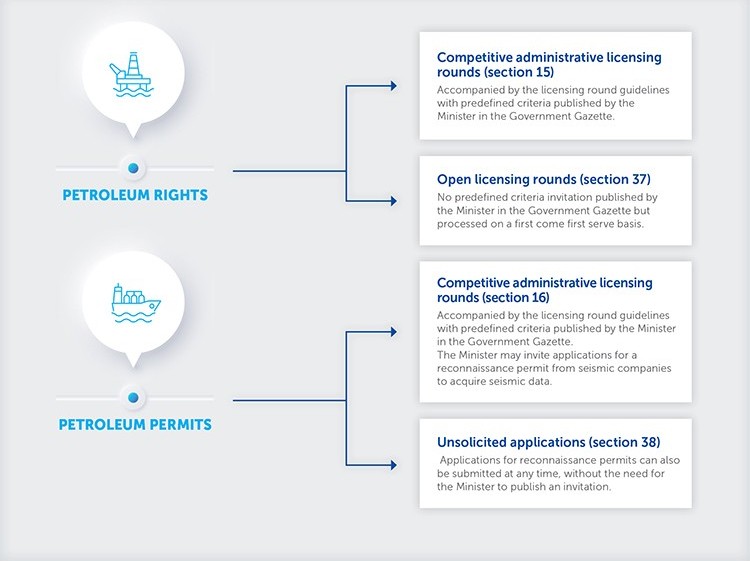
By contrast, the general rule for petroleum licensing under the Upstream Act begins with section 13, which empowers the Minister of Mineral and Petroleum Resources (Minister), on the Petroleum Agency’s recommendation, to initiate two types of licensing rounds upon notice in the Government Gazette: competitive administrative rounds (in terms of section 15 and 16 of the Upstream Act) and open licensing rounds (in terms of section 37 of the Upstream Act). A notable departure from this general rule is section 38 of the Upstream Act which allows for applications for reconnaissance permits to be submitted at any time without the Minister opening an invitation to submit applications under competitive administrative rounds or open licensing rounds. Licensing rounds are not foreign to the industry, with many countries such as Namibia, Nigeria, Ghana, and Brazil conducting licensing rounds in some form.
Licensing of new petroleum rights and permits:
General requirements of licensing rounds
Section 13 of the Upstream Act sets the general requirements for licensing rounds. As explained above, section 13 empowers the Minister to initiate competitive administrative or open licensing rounds on recommendation by the Petroleum Agency. In addition, section 13(3) and section 13(4) prescribe that a petroleum right granted in accordance with the licensing round procedure must be granted to a company incorporated in South Africa or, in the case of an unincorporated joint venture, all parties to such unincorporated joint venture must be incorporated in South Africa. In accordance with section 13(5) of the Upstream Act, the holders of such petroleum right granted in accordance with the licensing round procedure must also maintain an office in South Africa from which the petroleum activities will be managed.
Competitive licensing rounds
Competitive administrative licensing rounds for the acquisition of petroleum rights are governed by section 15 of the Upstream Act which provides that the Minister may invite applications for a specific block or blocks by publishing guidelines that set the application processes, evaluation parameters, minimum exploration work commitment for the initial term, documentation standards for technical and financial capability, data packages, and terms and conditions that will govern the acceptance, rejection and granting of these applications. Once the application phase has closed, the Petroleum Agency has 90 days to advance only one successful application to the environmental authorisation and consultation phase.
The Minister may also reserve blocks for 100% Black-owned entities, with these blocks being awarded through the competitive licensing rounds procedure outlined in section 15 of the Upstream Act.
Open licensing rounds
Under section 37 of the Upstream Act, the Minister may invite open applications for petroleum rights for a period designated in the invitation notice. The application process during these rounds is more akin to the application-led queue system of the MPRDA whereby the applications are dealt with on a first come, first served basis. Importantly, however, section 37(5) provides that if more than one application is received on the same day, preference must be given to applications received from Black persons.
Takeaways
The process for acquiring upstream rights and permits has undergone significant reform. Recent legislative and regulatory changes have streamlined the application pathways, clarified institutional responsibilities, and strengthened environmental and governance requirements. Notably, the previous fragmented system has been replaced with a more integrated licensing framework, reducing procedural duplication and improving predictability for investors. In parallel, updated environmental, social and technical compliance standards have been incorporated into the approval process, resulting in a more rigorous and transparent permitting environment. Collectively, these changes have modernised the upstream regulatory landscape and aligned it with contemporary industry, sustainability and policy expectations.
The information and material published on this website is provided for general purposes only and does not constitute legal advice. We make every effort to ensure that the content is updated regularly and to offer the most current and accurate information. Please consult one of our lawyers on any specific legal problem or matter. We accept no responsibility for any loss or damage, whether direct or consequential, which may arise from reliance on the information contained in these pages. Please refer to our full terms and conditions. Copyright © 2026 Cliffe Dekker Hofmeyr. All rights reserved. For permission to reproduce an article or publication, please contact us cliffedekkerhofmeyr@cdhlegal.com.
Subscribe
We support our clients’ strategic and operational needs by offering innovative, integrated and high quality thought leadership. To stay up to date on the latest legal developments that may potentially impact your business, subscribe to our alerts, seminar and webinar invitations.
Subscribe